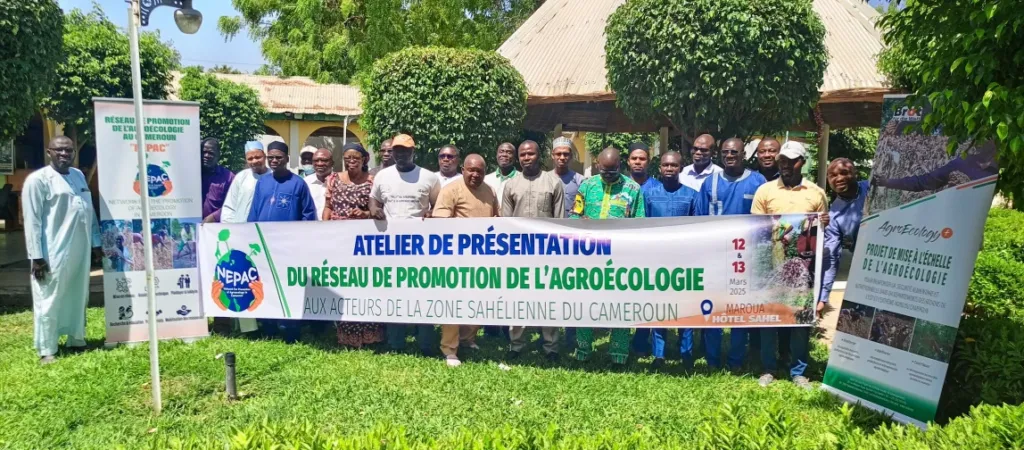
While local markets flourish in the south, the Agroecology Promotion Network in Cameroon (REPAC) is strategically extending its reach to the northern reaches of the country. On March 12 and 13, 2025, a pivotal workshop was held in Maroua, gathering over thirty key stakeholders from the North and Far North regions to establish the foundations of agroecology in the Sahelian zone.
Unifying a Fragmented Landscape
The expansion into the Sahel addresses a critical gap identified by SAILD in 2022. Previous mapping showed that while many actors were promoting sustainable practices, they often worked in isolation, leading to dispersed energy and overlapping intervention zones. By bringing together producers, civil society, and administrative officials in Maroua, REPAC is creating a unified front.
Sahelian Priorities and Action Plan
The workshop identified several urgent needs tailored to the unique challenges of the Sahel:
Awareness & Education: Increasing public understanding of agroecological concepts to foster a collective environmental consciousness.
Market Access: Identifying reliable outlets and value chains for agroecological products to ensure fair income for producers.
Technical Documentation: Producing and distributing “best practice” technical guides specifically adapted to Sahelian climates.
Academic Synergy: Developing partnerships with local agricultural schools to train the next generation of farmers.
Louis Nkembi, Vice-President of REPAC, emphasized that this regional initiative is about more than just food; it is about ensuring “stable and fair incomes” for smallholders facing difficult production conditions.
REPAC Stays the Course: Strategic Advocacy and National Policy
In addition to regional expansion, the network continues its high-level advocacy. From April 9 to 11, 2025, REPAC held its first General Assembly of the year in Kribi to solidify its operational plan and influence national environmental frameworks.
Strengthening the Network
After two years of growth, REPAC has established itself as a credible institutional partner. This was recently validated when the Ministry of Forests and Wildlife (MINFOF) selected the network to map cocoa orchards—a significant milestone for civil society involvement in national agricultural management.
The 2025 Roadmap: Influencing Climate Policy
The most critical mission for 2025 is integrating agroecology into Cameroon’s revised Nationally Determined Contribution (NDC). REPAC is currently drafting a formal proposal for the Ministry of Environment, positioning agroecology as a primary solution for carbon sequestration and climate resilience.
A Growing Movement
The journey from the Maroua workshop to the Kribi assembly confirms that agroecology is a multi-level movement. Whether through local market stalls or high-level policy papers, the goal remains the same: a resilient, equitable, and sustainable food system for all of Cameroon.